You hired an agency, got a logo, picked some colours, and called it done. Most Egyptian businesses stop there and wonder why their brand looks different on every piece of material their team produces. One department uses the old logo. The new agency uses a slightly different shade of blue. The sales team has been printing their own business cards since nobody sent them the files. A branding style guideline is the document that fixes all of this. It takes every decision that was made when building your brand and turns it into a set of rules that anyone can follow. This article covers what belongs in a proper brand style guideline, what most Egyptian agencies skip, and why those missing pieces are usually the ones that cost you the most.
If you are still at the stage of defining your brand before you document it, our complete guide to branding strategy covers the thinking that should come before this document exists.
What a branding style guideline actually is
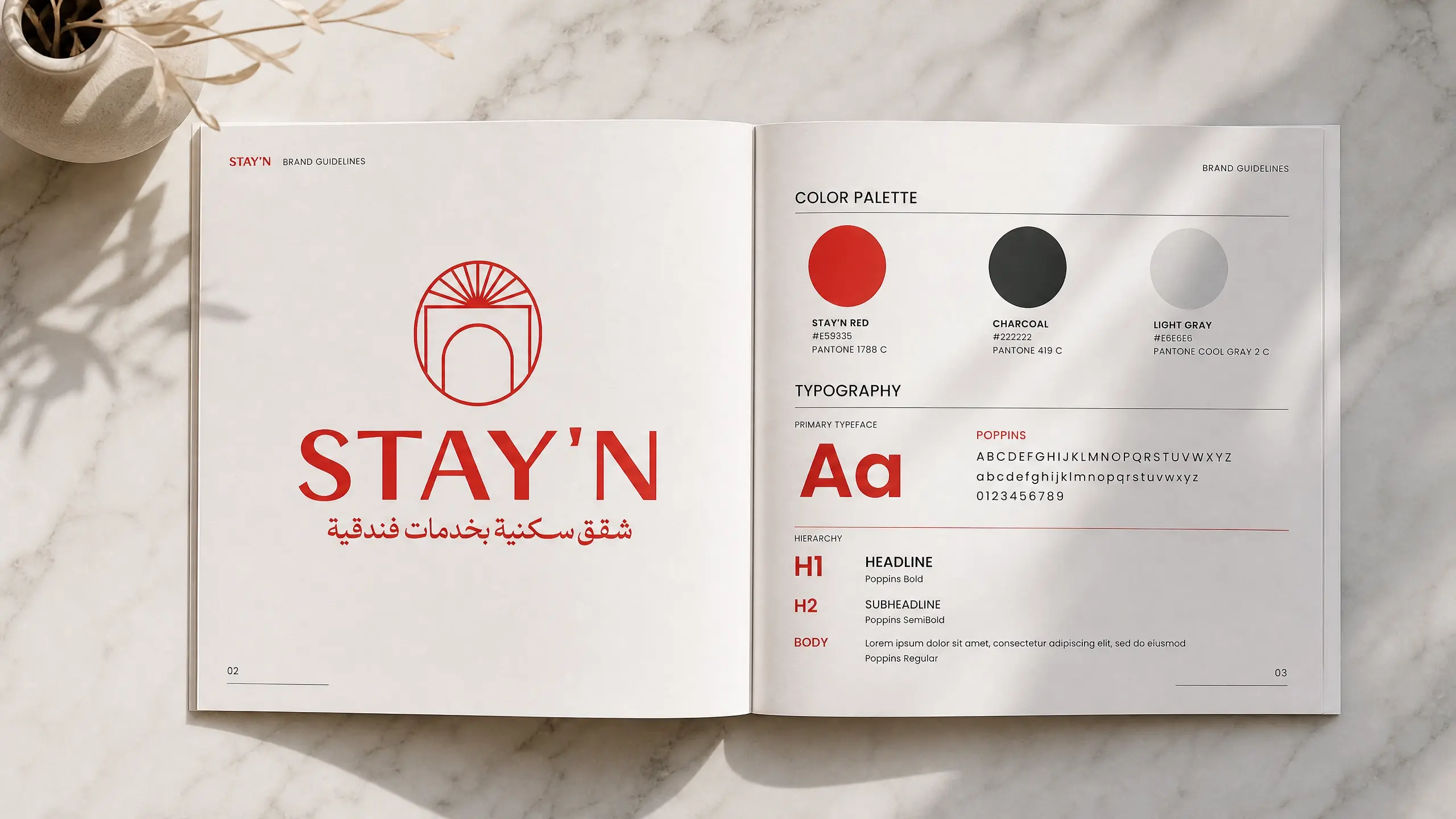
A branding style guideline, sometimes called a brand manual, brand book, or brand standards document, is the rulebook for how your brand looks and sounds across every touchpoint. It covers your logo, your colors, your typography, your photography style, and your tone of voice. It tells everyone who creates anything for your brand — your team, your agency, your printer, your social media manager — exactly how to represent it.
It is not just a logo file
A lot of Egyptian businesses think sending their agency the logo as a PNG file is enough. It is not. A logo file tells you what the logo looks like. A branding style guideline tells you how to use it, where to use it, how much space to leave around it, what backgrounds it should never appear on, and what the acceptable colour variations are. Without those rules, the logo gets stretched, recolored, placed on clashing backgrounds, and quietly mangled over time.
The difference between a style guideline and a brand strategy
Your brand strategy defines who you are and why. Your branding style guideline documents how that translates into every visual and verbal decision. One is the thinking; the other is the rulebook. If you haven’t yet solidified the ‘why’ behind your business, refer back to our branding strategy guide to ensure your rules have a solid foundation. Both matter, but they solve different problems. If you have not defined your strategy yet, the style guideline will have nothing solid to build on.
What every branding style guideline must include
Every brand is different but every style guideline needs to cover the same core sections. Here is what should be in yours.
Logo usage rules
This is the section most agencies rush and most businesses regret skipping. Your logo rules should cover the primary logo version, the secondary version (if there is one), the minimum size at which the logo can appear, the exclusion zone (the clear space that must always surround it), the approved color variations (full color, white, black, single colour), and the versions that should never be used. One page on logo usage prevents a year of inconsistent applications.
Color palette
Your color palette section should define your primary colours, your secondary colors, and your neutral tones. For each colour, include both the HEX code for digital use and the CMYK value for print. These are different. A blue that looks perfect on screen can print as purple if the CMYK values are not specified. This is one of the most common and most visible brand consistency failures we see with Egyptian businesses that have been operating for a few years without proper guidelines.
Typography
Define your primary typeface, your secondary typeface, and the hierarchy for how they are used. Which font is for headlines? Which is for body text? What size should a heading be on a brochure versus a social media post? Typography rules prevent your brand from looking like someone chose fonts at random depending on who was designing that day.
Imagery guidelines
Describe the photography and illustration style that represents your brand. What kind of images fit the brand and what kind do not? A luxury real estate developer might specify: wide-angle architecture photography, natural light, minimal human presence, neutral color grading. Without this guidance, your social media manager will use stock photos that feel nothing like the brand and your agency will use a completely different style for the brochure.
Tone of voice document
This is the written equivalent of your visual rules. How does your brand sound? Define it in three words, give examples of copy that is on-brand and copy that is off-brand, and specify whether the brand uses formal or informal Arabic, whether it uses humour, and how it addresses the reader. A tone of voice document is especially important in Egypt where the gap between formal and colloquial language is significant and the wrong choice for your audience reads immediately as out of place.
[Image]What most agencies leave out — and why it matters
A basic branding style guideline covers logo, colours, and fonts. A proper one goes further. These are the sections most Egyptian agencies skip that cause the most problems down the line.
Logo exclusion zones and minimum sizes
An exclusion zone is the minimum clear space that must always surround your logo. Without it defined, someone will place your logo directly next to another element and it will look crowded, amateur, or unintentional. Minimum size rules prevent your logo from being used so small it becomes illegible. These are two lines in the document. They save years of inconsistency.
Digital versus print colour specifications
HEX codes work for screens. CMYK values work for print. RGB values work for certain digital formats. If your guidelines only provide one of these, whoever is preparing your materials for a different medium will guess, and they will guess wrong. Specify all three for every colour in your palette. Maintaining visual harmony across platforms is a universal challenge; even tools like Canva emphasize the importance of a centralized brand kit to prevent color and font drift in digital designs.
Dark and light background variations
Your logo needs to work on both dark and light backgrounds. If your primary logo is dark, you need an approved white or light version for when it sits on a dark background. If this is not in the guidelines, designers will either avoid dark backgrounds entirely or create their own version of the logo that was never approved.
What the brand should never look like
This is the section almost nobody includes and almost everyone needs. Show three or four examples of incorrect logo usage, incorrect colour combinations, and off-brand tone of voice examples. It is much easier to understand what is wrong by seeing it than by reading a rule about it. This section prevents more brand damage than almost anything else in the document.
If you want to understand how these rules connect back to the overall brand strategy, our article on how to create a brand strategy outline explains the decisions that feed into the style guideline.
What happens when you do not have one
If you are still not convinced a branding style guideline is worth the investment, consider what is happening without one.
Your sales team and your agency apply the brand differently
Without a shared reference document, everyone who touches the brand makes their own decisions. Your sales team uses the version of the logo they downloaded from WhatsApp two years ago. Your agency uses the version from the last brief. Your print supplier uses whatever the client sent them. Three different applications of the same brand, none of them wrong intentionally, all of them eroding the consistency your brand depends on.
Every new vendor starts from scratch
Every time you brief a new agency, a new printer, or a new social media manager, they need to understand your brand from the beginning. Without a style guideline you spend hours in briefings explaining what should already be documented. With one you send a single file and the work starts immediately.
The brand dilutes slowly and you do not notice until it is too late
Brand inconsistency is cumulative. One slightly wrong colour here, one off-brand image there, one headline in the wrong font. None of them are disasters on their own. Together, over a year or two, they add up to a brand that no longer looks like itself. By the time most Egyptian businesses notice, they are talking about a rebrand when the real solution was a style guideline three years earlier.
A branding style guideline checklist for Egyptian businesses
Use this checklist to assess whether your current brand guidelines are complete. If you are building one from scratch, work through each item in order.
| Branding Style Guideline Checklist | |
| ☐ | Primary logo — full colour version with clear space defined |
| ☐ | Secondary logo — simplified or stacked version for small applications |
| ☐ | Logo colour variations — white version, black version, single colour version |
| ☐ | Logo exclusion zone — minimum clear space around the logo specified |
| ☐ | Logo minimum size — smallest size at which the logo can appear |
| ☐ | Incorrect logo usage examples — at least 3 examples of what not to do |
| ☐ | Primary colour palette — HEX, CMYK, and RGB values for each colour |
| ☐ | Secondary colour palette — supporting colours with all specifications |
| ☐ | Typography — primary typeface, secondary typeface, and hierarchy rules |
| ☐ | Imagery guidelines — photography style, illustration style, what to avoid |
| ☐ | Tone of voice — three brand voice words, on-brand examples, off-brand examples |
| ☐ | Arabic language guidance — formal versus colloquial, punctuation preferences |
| ☐ | Digital specifications — social media sizes, file format requirements |
| ☐ | Print specifications — bleed, safe zones, preferred file formats |
How to get yours done without overcomplicating it
The best branding style guideline is the one your team will actually use. A 60-page brand book that lives on a shelf helps nobody.
Start with what you have
If you already have a logo, colours, and fonts defined, you are halfway there. Document the rules around what you already have. Add the missing sections. You do not need to redesign anything to create a useful set of guidelines.
Keep it to one document
Everything in one PDF or one shared file. Not a folder of separate documents that nobody can find. Not a presentation deck that was sent once and never updated. One file, shared with everyone who touches the brand, updated when the brand evolves.
When to update it
Review your style guideline when you launch a new product line, enter a new market, change your visual identity, or when your team grows significantly and new people are applying the brand without enough context. Do not update it because a campaign did not perform. The guidelines are a long-term document, not a reaction to short-term results.
If you are starting from the very beginning and need to understand what should exist before your guidelines, our article on what is branding strategy is a useful starting point.
How Native Studio builds brand guidelines for Egyptian businesses
Every brand guidelines document we produce at Native Studio is built after the strategy is defined, not before. The guidelines document what was decided during the strategy process — the positioning, the visual identity direction, the tone of voice. It captures those decisions in a format that anyone can apply consistently.
For EHD, the guidelines needed to communicate a brand that was built to reflect Egyptian-Hungarian heritage. For C Developments, they needed to capture a company that had grown from residential to large-scale commercial and mixed-use development. For Salam Communities, they needed to reflect a specific lifestyle promise made to a very specific buyer. Each set of guidelines is different because each brand is different. The format is consistent. The content is always specific.
Frequently asked questions
Q: What is the difference between a brand style guide and brand guidelines?
They are the same thing described with different names. Some agencies call it a brand manual, others call it a brand book or brand standards document. The content is the same: rules for how your brand looks and sounds across every touchpoint.
Q: How long should a branding style guideline be?
Long enough to cover every section clearly, short enough that people will actually use it. For most Egyptian businesses, 10 to 20 pages is ideal. Global corporations produce 60-page documents because they have hundreds of people applying the brand across dozens of markets. For a business operating primarily in Egypt, a focused 15-page document is more useful than a comprehensive one that nobody reads.
Q: Do I need a branding style guideline if I am a small Egyptian business?
Yes, and the earlier you create one the better. The businesses that benefit most from a style guideline are the ones that are growing and starting to involve more people in producing their brand materials. Once three or more people are creating content for your brand, a style guideline becomes essential rather than optional.
Q: What happens if I do not have brand guidelines?
Your brand will be applied inconsistently across every touchpoint. Over time this accumulates into a brand that no longer looks or sounds like itself. The cost is not dramatic in the short term but it compounds significantly over two to three years. Most Egyptian businesses that come to us for a rebrand could have avoided it with a proper style guideline five years earlier.
Q: Should my branding style guideline include Arabic language rules?
Yes, especially if you communicate with Egyptian audiences in both languages. Arabic has specific considerations around formal versus colloquial tone, punctuation styles, and how the brand name appears in Arabic characters. These should be documented with the same level of care as the English guidelines.
To summarize
A branding style guideline is not a complicated document. It is the rulebook that keeps your brand consistent across every person and every platform that touches it. The businesses that invest in getting it right early spend less time correcting brand inconsistency later and more time building the recognition that makes their marketing actually work.
Most Egyptian agencies will deliver a logo and a colour palette and call the brand done. A proper branding style guideline goes further. It covers everything from logo exclusion zones and print colour specifications to tone of voice examples and what the brand should never look like. That level of detail is what separates a brand that holds together over time from one that gradually becomes unrecognizable. Before you finalize your manual, ensure your core identity is rock solid by revisiting our branding strategy guide—the essential first step for any Egyptian business looking to scale
If you want to see what a complete set of brand guidelines looks like for an Egyptian business, take a look at our work and see how we have built brand standards for EHD, C Developments, Salam Communities, and more.