As a real estate developer in New Cairo, you might have a premium project, a strategic location, and competitive pricing. But so does your competition. When a high-net-worth buyer starts comparing developments, your project risks looking identical to the five others on their screen. Same lifestyle photography. Same generic typography. Same promises. When the market cannot tell the difference, buyers default to the cheapest option or whoever reaches them first.
That is not a marketing problem. That is a structural branding strategy problem.
Branding strategy is the commercial intelligence that dictates everything your audience sees, reads, and feels about your business. As a premium branding agency, Native Studio architects this exact framework to help Egyptian developers command a premium price per square meter, while competitors offer the same product for less and still lose the deal. This guide breaks down what a highly profitable branding strategy actually involves, how to build one, and where corporate brands in the MENA region succeed or fail.
What is branding strategy?
A true branding strategy definition comes down to this: it is a long-term plan that dictates exactly how a business will be perceived by its audience. It covers who you are, what you believe in, how you sound, how you look, and how you fiercely position yourself against everyone else in your market.
It is not a logo. It is not a color palette. Those are merely the visual outputs of a branding strategy, not the strategy itself.
| A logo is what people see. A branding strategy is why they remember you. |
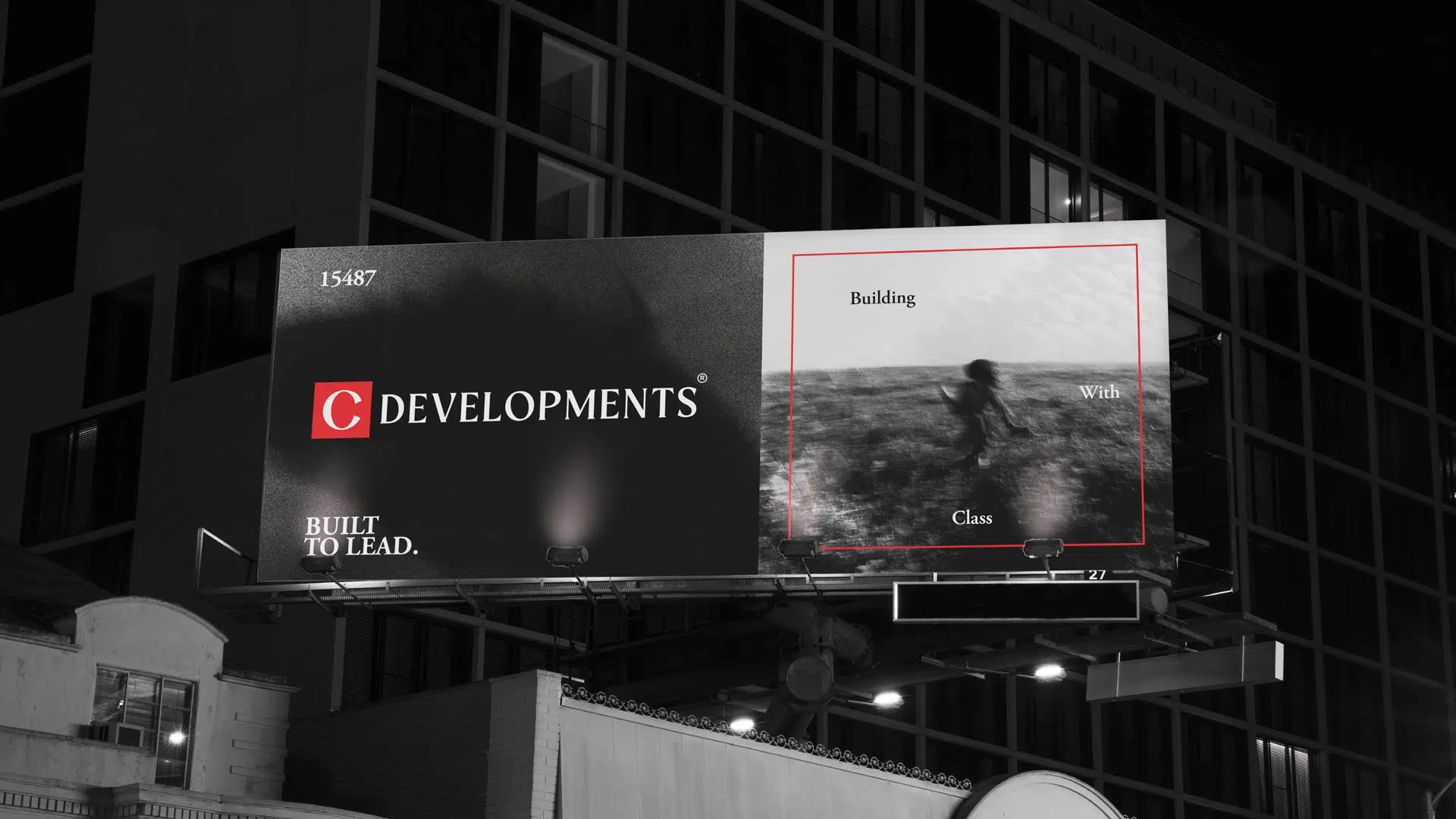
Think about C Developments, formerly known as Cairo Heights Developments. When they made the decision to rebrand, they were not just changing their name and visual identity. They were communicating a strategic shift toward larger commercial and mixed-use projects. That shift in positioning, in audience, in message, was the strategy. The new logo and name were simply how that strategy became visible.
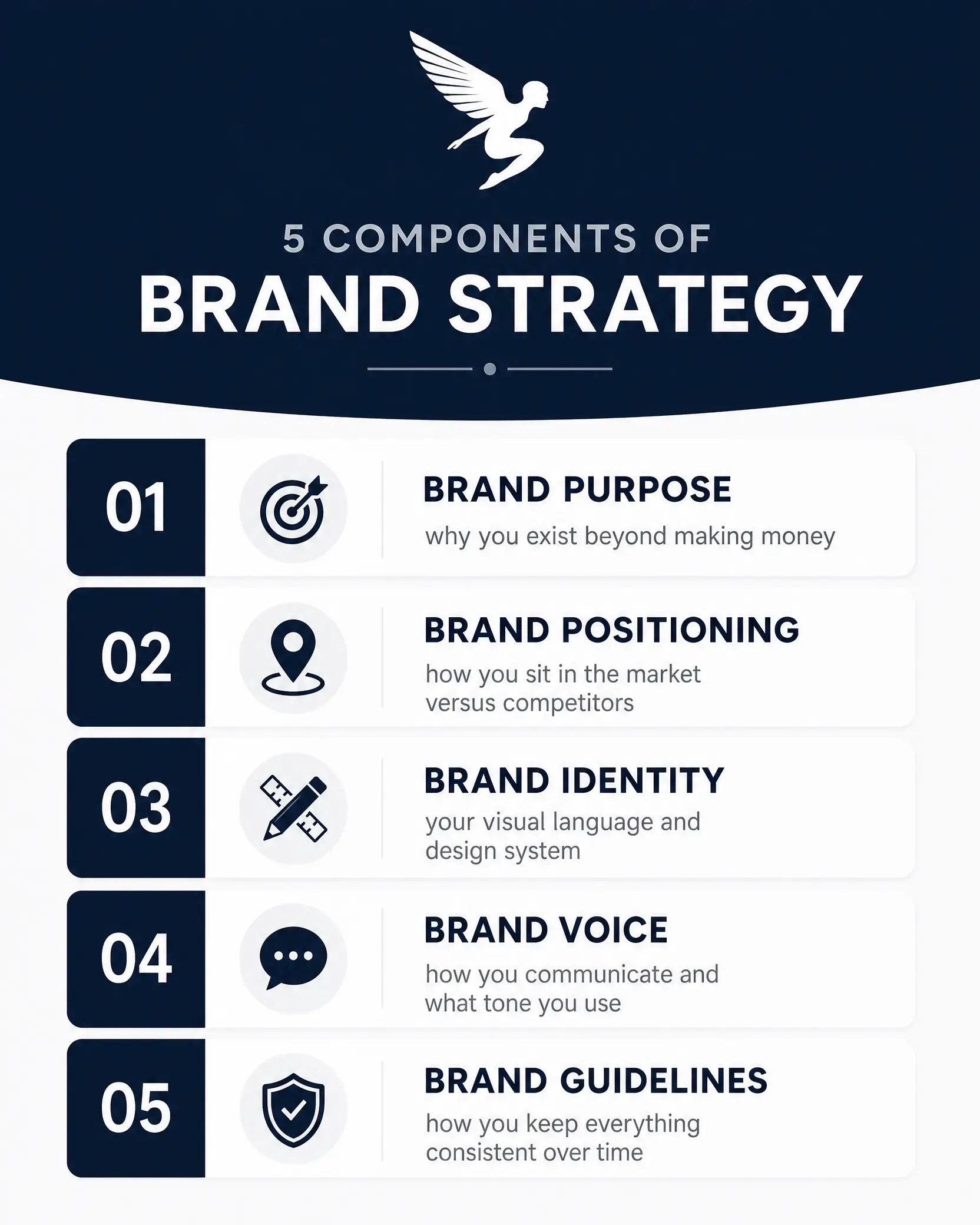
A complete branding strategy includes:
- Your brand purpose — why you exist beyond making money
- Your brand positioning — how you sit in the market versus competitors
- Your brand identity — your visual language and design system
- Your brand voice — how you communicate and what tone you use
- Your brand guidelines — how you keep everything consistent over time
Why Branding Strategy Dictates Market Survival in Egypt
The Egyptian real estate market is heavily saturated. Across New Cairo and the North Coast, hundreds of developers are fighting for the exact same high-net-worth buyers, yet most look and sound completely interchangeable.
Consider two adjacent North Coast projects. Developer A relies on a rigorous branding strategy, positioning their development as an exclusive Mediterranean enclave. Every visual and message reinforces this premium status. Developer B offers a similar product but uses generic, one-size-fits-all marketing.
The outcome? Developer A commands a premium price per square meter and closes deals faster. Developer B is forced into a price war. Developer A wins the market not through superior architecture, but through superior brand clarity.
This reality extends across all booming Egyptian sectors. A robust branding strategy is the only mechanism to cut through market noise—a fact starkly visible in how top-tier developers dominated with their Ramadan 2024 campaigns.
The 5 Core Elements of a Profitable Branding Strategy
1. Brand Purpose (The Strategic North Star)
Your brand purpose is the foundational mission that drives corporate decisions and builds genuine market trust. An Egyptian developer whose core purpose is to deliver accessible premium living will engineer pricing, architecture, and marketing far differently than one merely chasing profit margins. This purpose becomes the ultimate filter for every executive decision.
2. Brand Positioning (The Market Stance)
Positioning dictates where you sit relative to your competitors and answers the ultimate buyer question: Why you? A North Coast developer targeting Cairo’s elite commands a completely different lifestyle promise, price point, and visual language than an October City developer targeting first-time buyers. Positioning engineered correctly removes you from price wars.
3. Brand Identity (The Visual Architecture)
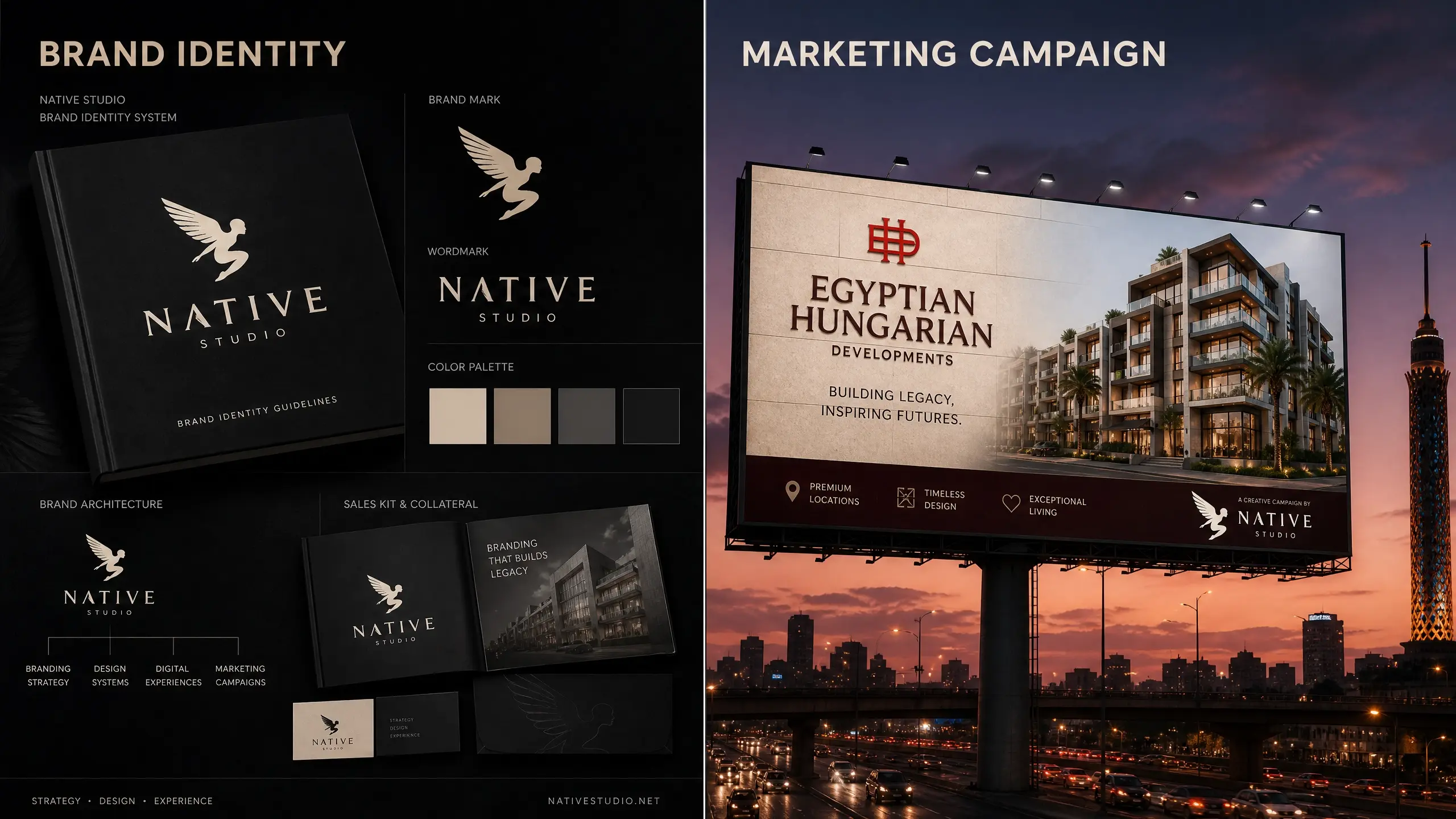
This encompasses your logo, color psychology, typography, and overarching design system. The fatal mistake most Egyptian businesses make is starting here. Visual identity without strategy is merely decoration. When Native Studio architected the identity for EHD-Egyptian Hungarian Developments, every design choice was rooted in corporate strategy. The identity had to seamlessly blend Egyptian-Hungarian heritage, appeal to a highly specific premium buyer, and project elite quality without feeling inaccessible. It was not just art; it was a commercial translation of the brand.
4. Brand Voice (The Verbal Equity)
Your voice is how you communicate: the tone, the vocabulary, and the personality echoing through every touchpoint. The gap between a heritage luxury brand in Zamalek and a youth-focused developer in New Cairo is not just visual—it is verbal. The luxury brand speaks with quiet, unshakeable confidence; it never shouts. The youth developer speaks with warm inclusion. Both convert their target audience, but if their voices were swapped, both would fail.
5. Brand Guidelines (The Corporate Playbook)
Branding style guidelines are the rulebook that protects your brand equity from dilution. They dictate precise logo usage, color hierarchies, and tonal consistency across all channels. Without this governance, visual chaos ensues. We frequently see Egyptian developers losing market credibility because their sales team uses one logo version, the media agency uses another, and the corporate website features a third. Every inconsistency bleeds market trust.
Branding strategy vs marketing strategy
One of the most costly points of confusion for Egyptian developers and C-level executives is misunderstanding the true role of a branding strategy and marketing. The executive summary is simple: branding dictates who you are; marketing dictates how you sell it.
Your brand is the structural constant, while your marketing campaigns are tactical executions that sit on top of it. Consider Vodafone Egypt: their brand equity has been anchored in their distinctive red, their confident tone, and a core promise of connection for over two decades. While their marketing campaigns pivot every season or product launch, the corporate brand remains unshakeable. The market recognizes them instantly, regardless of the specific tactical campaign.
When marketing and branding are misaligned, the cognitive dissonance destroys ROI. A real estate developer running a multimillion-pound marketing campaign promising “exclusive luxury”—while their brand assets look generic and cheap—creates a massive gap between the commercial promise and reality. That gap destroys market trust and kills conversions.
| Branding Strategy (The Foundation) | Marketing Strategy (The Execution) |
| Defines the corporate identity (Who you are). | Promotes products or services (What you offer). |
| Long-term, consistent, and structural. | Short-term, tactical, and campaign-driven. |
| Builds deep emotional equity and market trust. | Drives specific, measurable actions (leads, sales). |
| Remains steadfast across years and market cycles. | Pivots constantly with seasons, trends, and launches. |
| Dictates and filters every marketing decision. | Executes on top of the established brand foundation. |
| Example: Vodafone’s iconic red and bold tone. | Example: Vodafone’s seasonal Ramadan offers. |
How to Architect Your Branding Strategy: A Step-by-Step Execution
Executing a corporate identity transition requires a rigorous, documentable framework—something your leadership team can structure using a formal brand strategy outline. To demonstrate how this theoretical framework translates into actual commercial success, we will break down these steps using a live Native Studio case study.
Salam Properties approached us with a tangible real estate product and a clear target demographic, but they lacked the cohesive corporate identity required to capture premium buyers. They had a physical product, but no structural way to present its value to the market. Here is the exact step-by-step process we used to architect their brand from the ground up.
1- Audience Mapping and Diagnostic
Before anything else, you need to know exactly who you are building this brand for. Not a general description like ‘upper middle class Egyptians’ but a specific picture of the person making the buying decision.
For Salam Properties, the audience was Egyptian families in their 30s and 40s who had achieved financial stability and were ready to invest in a lifestyle, not just a property. Understanding that specific buyer informed every decision that followed.
2- Strategic Market Positioning
Once you know your audience, define where you sit in the market. What makes you different from the alternatives your audience is considering? What is your unfair advantage?
Positioning is not about being the best. It is about being the most relevant to a specific audience.
3- Defining Corporate Purpose and Values
Your purpose is the why behind everything. Your values are the principles that guide how you operate. Both should be specific enough to actually inform decisions, not generic statements that apply to any business.
Avoid values like ‘quality’ and ‘integrity.’ Every business claims those. Find the values that are genuinely specific to how you work.
4- Visual Architecture and Design Systems
Now the visual work begins. Logo, color palette, typography, photography direction, and design system. This is where strategy becomes tangible.
Every visual decision should trace back to the strategy. If your brand is about accessible luxury for Egyptian families, your visual identity should feel premium but not cold, warm but not casual. The tension between those two requirements is where interesting design lives.
5- Establishing Brand Governance (Guidelines)
Document everything. How the logo is used and how it is not. Which colors are primary and which are accents. How the brand sounds in a formal context versus a social media post. This document is what keeps the brand consistent as the business grows.
6- Relentless Omnichannel Execution
A branding strategy only works if it is applied consistently. Every touchpoint, from the sales brochure to the Instagram post to the email signature, should feel like it comes from the same place.
Consistency builds recognition. Recognition builds trust. Trust builds preference. Preference drives sales.
Real Egyptian brand examples from Native Studio
The following examples are from actual Native Studio projects. Each one shows branding strategy at work in the Egyptian market.
C Developments — strategic repositioning
Cairo Heights Developments had built a track record in residential projects but wanted to move into larger commercial and mixed-use development. The problem was that their name and identity communicated the old positioning, not the new one.
The rebrand to C Developments was not just a name change. It was a strategic signal to the market: this company thinks bigger now. The new identity was built to communicate scale, commercial credibility, and ambition. Every decision about the new visual language came from that strategic brief. See the full C Development portfolio.
 EHD — brand creation from the ground up
Egyptian Hungarian Developments came to Native Studio needing a brand built from scratch. The challenge was communicating a heritage that is genuinely unique in the Egyptian market: Egyptian roots with European partnership, without it feeling forced or unfamiliar to the local buyer.
The brand identity Native Studio created for EHD draws on both cultures without leaning too heavily on either. The result is a brand that feels premium and distinctive in a market where most competitors look very similar. See the full portfolio of EHD.
 Golden View — luxury positioning on the North Coast
Golden View needed to position as a luxury offering in a competitive North Coast market. The challenge was communicating genuine exclusivity without alienating buyers who aspire to luxury but are sensitive to anything that feels inaccessible or arrogant.
The brand strategy for Golden View defined a tone of quiet confidence, a visual identity built around restraint and quality, and a positioning that made the buyer feel that choosing Golden View was a reflection of their own good taste rather than a purchase they needed to justify. See Golden View full portfolio.
The 5 Costly Branding Mistakes Draining Egyptian Enterprises
After partnering with top-tier Egyptian developers, Native Studio consistently diagnoses the same five ROI-draining missteps:
- Executing Design Before Strategy: Rushing a logo before defining your market stance creates a fragile identity that collapses when the business scales or the market shifts.
- The Sea of Sameness: Defaulting to the “safe middle ground” makes your project visually identical to every other New Cairo or North Coast development. In real estate, visual safety equals commercial invisibility.
- Reactive Rebranding (Capital Bleed): Burning through three logos in five years is not a design issue; it is a costly, knee-jerk reaction to a missing foundational strategy.
- Zero Brand Governance: Without strict corporate guidelines, sales teams and external agencies create fragmented visual chaos that severely erodes buyer trust.
- Treating Branding as an Expense: A brand is not a one-off operational cost that ends at launch. It is an appreciating commercial asset that secures long-term market dominance.
How Native Studio Architects Branding Strategy
Native Studio is a premier Cairo-based strategic branding agency. Through our comprehensive corporate branding services, we specialize in engineering identities for Egyptian real estate developers and high-growth enterprises that refuse to be invisible in saturated markets.
Our methodology is strictly diagnostic: strategy precedes design. Before a single visual element is drafted, we work directly with your leadership team to construct a comprehensive corporate branding blueprint. We define your exact market positioning, your high-net-worth audience, your corporate purpose, and your competitive vulnerabilities. The visual architecture that follows is merely the commercial translation of this rigorous foundation—ensuring your brand equity compounds over decades, not months.
This precise strategic framework is what built the market authority of our partners, including C Developments, EHD, Salam Properties, APlus, and Golden View. None of these were mere design projects; they were calculated market repositionings where strategy dictated every creative decision.
If your enterprise is ready to stop treating branding as decoration and start building an asset that commands a premium, it is time to talk.
Frequently Asked Questions
What is the exact difference between a logo and a brand?
A logo is a single visual asset; a brand is a comprehensive commercial ecosystem. While a logo identifies your business, your branding strategy dictates your market positioning, corporate voice, and customer perception. A logo without a strategic foundation is merely decoration, whereas a brand is what makes that mark hold financial value.
How long does it take to develop a corporate branding strategy in Egypt?
Architecting a robust corporate identity typically requires 6 to 12 weeks for the strategic and diagnostic phases, depending on market complexity. Visual identity development adds another 4 to 8 weeks. Rushing this structural process almost always results in a fragile identity that forces you into a costly rebranding strategy within a year.
Do boutique or mid-sized Egyptian businesses really need a branding strategy?
Absolutely. Branding is not exclusive to corporate giants. Whether you are a boutique developer, a law firm, or a specialized B2B enterprise, a documented brand strategy outline is what allows you to compete with larger players. It dictates how you capture market share and command premium pricing, scaling seamlessly as your enterprise grows.
What is the absolute first step in building a brand?
Market diagnosis and audience definition. Before touching a single design element, you must map exactly who you are targeting—with extreme specificity—and what commercial problem you solve for them. Everything in brand building flows from this diagnostic clarity. Without it, every subsequent executive decision is just a guess.
How do I know if my enterprise needs a brand refresh or a full rebrand?
A brand refresh is a visual update (modernizing typography, refining colors) applied when your core strategy still works but looks dated. A full corporate rebrand is required when your current identity actively damages your sales, your target audience has shifted, or you are navigating a major merger. Confusing branding and rebranding is a costly mistake.
What is the true ROI of investing in a professional branding strategy?
The return on investment manifests in reduced price sensitivity, shorter sales cycles, and increased market equity. A structurally sound brand allows you to command premium prices and drastically improves the conversion rates and ROI of your tactical marketing campaigns.
Can we execute marketing campaigns without a foundational brand strategy?
Executing marketing without a brand foundation is a massive capital bleed. Implementing a proper branding strategy in marketing ensures that every ad dollar spent builds long-term corporate equity rather than just short-term noise. Marketing is how you promote your offers; branding is who you are. When the two are misaligned, you lose buyer trust.
Why is corporate branding so critical for real estate developers in Egypt?
The Egyptian property market is fiercely saturated. When architectural specs and prime locations (like New Cairo or the North Coast) are similar across developers, brand equity is the only differentiator. To successfully rebrand a real estate company, you must build an identity that projects absolute financial stability and elite lifestyle promises to high-net-worth buyers.
What are brand guidelines, and are they strictly necessary?
Brand guidelines are your corporate playbook. They enforce strict rules on logo usage, typography, and tone of voice across all internal departments and external media agencies. Without this strict governance, visual chaos ensues, which instantly dilutes your market authority and makes the brand look unprofessional.
What should leadership teams look for when hiring a branding agency in Egypt?
Look for a premium branding agency that prioritizes business strategy over mere aesthetics. A capable agency will start with a deep diagnostic of your sales process, market positioning, and competitive landscape before ever discussing color palettes or logo designs.
Securing Your Market Dominance
Branding strategy is no longer a marketing luxury; it is the ultimate commercial differentiator in Egypt’s hyper-competitive sectors. From the saturated real estate clusters of New Cairo to the expansive luxury developments on the North Coast, the enterprises that command premium pricing are those with a relentless, strategically engineered brand.
A logo does not close a high-net-worth deal. A profound, structurally sound corporate identity does. The developers and executives who invest in this strategic foundation achieve far more than aesthetic appeal—they eliminate price sensitivity, accelerate their sales cycles, and build generational market equity that compounds over time.
The era of competing on generic promises is over. You can explore HubSpot’s branding guide to see how these exact principles dictate market leadership worldwide, or you can take immediate action locally.
If you are ready to transition your corporate identity from a mere visual mark into a high-performing commercial asset, it is time to build your foundation with Native Studio.
Call us Whats app