Most Egyptian businesses have a logo, a color palette, and maybe a tagline. What they rarely have is a brand strategy outline — the document that explains why all of those things exist and how they fit together. Without it, every marketing decision becomes a debate, every new campaign feels like starting from scratch, and two years later you are rebranding because nothing ever felt quite right. This article gives you a practical six-section outline you can fill in today, with examples from Egyptian businesses and developers at every step.
Not sure what a brand strategy covers before you start? Our complete guide to branding strategy explains every element clearly before you put pen to paper.
What a brand strategy outline actually is
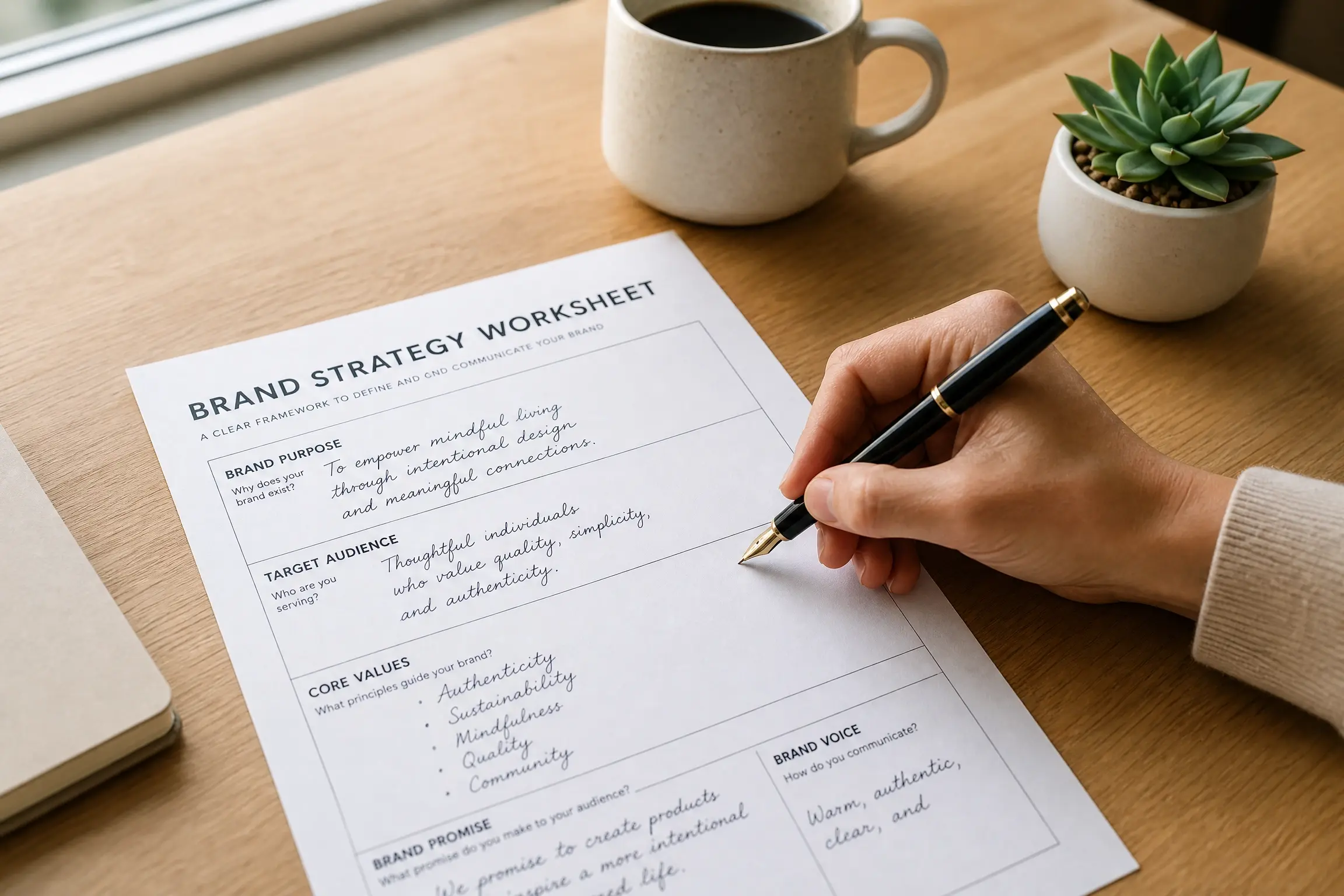
You have probably seen brand strategy documents that are 40 pages long and read like a legal contract. That is not what we are talking about. A brand strategy outline is a working document, usually one to two pages, that captures the most important decisions about your brand in one place. It answers the questions your team, your agency, and your sales staff would otherwise guess at.
What it includes
Your purpose, your audience, your competitive position, your identity direction, and your brand voice. Six sections, each one informing the next. Fill them in sequence because each answer shapes the one that follows.
What it does not include
It is not a brand guidelines document. It is not a marketing plan. Those come after. The outline is the foundation everything else sits on. Think of it as the brief that makes every other brief easier to write.
Section 1 of the outline — brand purpose and mission
This is the hardest section to write and the most important one to get right. Your brand purpose is why your business exists beyond making money. Your brand mission is what you are specifically trying to do to live up to that purpose.
How to write your brand mission in one sentence
Avoid vague language like to deliver excellence or to provide quality solutions. Every Egyptian business claims those. A useful brand mission is specific enough to rule things out. If your mission statement could apply to any company in your industry, it needs more work.
The difference between brand mission and brand vision
Your brand mission is what you are doing now. Your brand vision is where you want to be in five years. Both belong in the outline. Azza Fahmy’s mission is to celebrate Egyptian craftsmanship through contemporary jewelry. Their vision is to make that craftsmanship recognized globally. One describes today. The other describes where the brand is heading. Separating them makes both clearer.
Section 2 of the outline — target audience
Most Egyptian businesses define their audience too broadly. Upper middle class Egyptians aged 25 to 45 are not a target audience. It is a census category. A useful audience description is specific enough that you could picture a real person.
How to build a buyer persona for the Egyptian market
Think about your actual best client, not your average client. Where do they live? What do they worry about? What does success look like for them? For a real estate developer, the North Coast buyer and the New Cairo buyer are completely different people even if they have similar incomes. Their motivations, their family situations, and what they want the property to say about them are different. Your brand needs to speak to one of them clearly rather than both of them vaguely.
Why specificity wins in Egypt’s market
Egypt’s market has real economic and cultural diversity. A brand that tries to speak to everyone usually resonates with no one. The businesses that grow fastest are almost always the ones that chose a specific audience and went deep rather than wide.
Section 3 of the outline — competitive analysis
You do not need a 20-page competitive analysis. You need to answer one question: what are your top three competitors doing, and what gap are they leaving?
What to look for when analyzing Egyptian competitors
Look at how they position themselves, how they sound, who they seem to be speaking to, and what they consistently talk about. Then look for what they consistently avoid or miss. That gap is usually where the most useful positioning lives.
Understanding how Egyptian culture shapes brand decisions is a useful starting point for any competitive analysis. Think Marketing Magazine covers this well if you want to go deeper on the cultural side before writing this section.
Example — two similar Egyptian developers
Two developers launched projects in New Cairo at similar price points. One position is around community and lifestyle — greenery, amenities, belonging. The other positions around investment return and capital appreciation. Same location, same price, completely different audiences and brand strategies. Neither is wrong. But you cannot do both and do either well.
Section 4 of the outline — positioning statement
Your positioning statement is a single sentence that captures who you are for, what you offer, and why you are different. It is an internal tool, not a tagline. You do not put it on your billboard. You use it to make sure every external communication points in the same direction.
The formula
We help [specific audience] achieve [specific outcome] unlike [competitor approach] because [specific reason].
A Native Studio client example
We worked with an Egyptian real estate developer whose positioning statement became: We help Egyptian families in their 30s and 40s invest in a lifestyle they are proud of, unlike developers who lead with price, because we build communities worth living in rather than units worth buying. That one sentence changed how they briefed agencies, wrote copy, and selected project photography. Everything became clearer because the positioning was clear.
If you want to understand how positioning feeds into your overall brand strategy, the complete guide to branding strategy covers this in detail with more Egyptian examples.
Section 5 of the outline — brand identity direction
This is where most Egyptian businesses start. It should actually be section five. Every visual decision — your logo direction, your colors, your typography, your photography style — should come after you have answered the four sections above. Identity without strategy is decoration.
What to define here
You do not need to design anything at this stage. Write down the feeling your visual identity should create and the feeling it should avoid. When Native Studio rebranded Cairo Heights Developments into C Developments, the visual identity needed to communicate something very specific — a company that had grown beyond residential buildings and was now operating at a larger commercial and mixed-use scale. That single idea, bigger ambition, bolder positioning, shaped every visual decision. The new name, the logo, the color palette, the typography. All of it came from understanding where the brand was going before anyone opened a design tool.
Section 6 of the outline — brand voice
How does your brand sound? Pick three words that describe it. Then pick two words that describe how it does not sound. That is your brand voice brief.
Egyptian market nuances
Brand voice in Egypt is not one size fits all. A Ramadan campaign calls for warmth, nostalgia, and family. An everyday product launch calls for something more direct and practical. A luxury developer on the North Coast speaks differently from an affordable developer in 6th of October targeting first-time buyers. Your brand voice stays consistent underneath all of these contexts. The tone adjusts, but the character does not.
How to keep it consistent across channels
Write it down. One paragraph, three words you sound like, two words you avoid, two example sentences that feel right, and one example sentence that feels wrong. That is enough for your team to apply it consistently without a 40-page brand manual sitting on a shelf that nobody reads.
The brand strategy outline — fill it in for your business
Here is the full framework in one place. Copy it, fill it in, and use it as the reference point for every brand decision you make from here.
| Section | What it covers | Your answer |
| 1. Brand purpose | Why does your business exist beyond making money? | |
| 2. Brand mission | What are you trying to achieve? One clear sentence. | |
| 3. Brand vision | Where do you want the brand to be in 5 years? | |
| 4. Target audience | Who is your ideal buyer? Be specific about age, location, lifestyle, and what they care about. | |
| 5. Competitive analysis | Who are your top 3 competitors? What gap do they leave? | |
| 6. Positioning statement | We help [audience] achieve [outcome] unlike [competitor] because [reason]. | |
| 7. Brand identity | What feeling should your visual identity create? What feeling should it avoid? | |
| 8. Brand voice | Three words that describe how you sound. Two words you avoid. |
Download this framework as a PDF, fill it in for your business, and use it as the foundation for every brand decision you make.
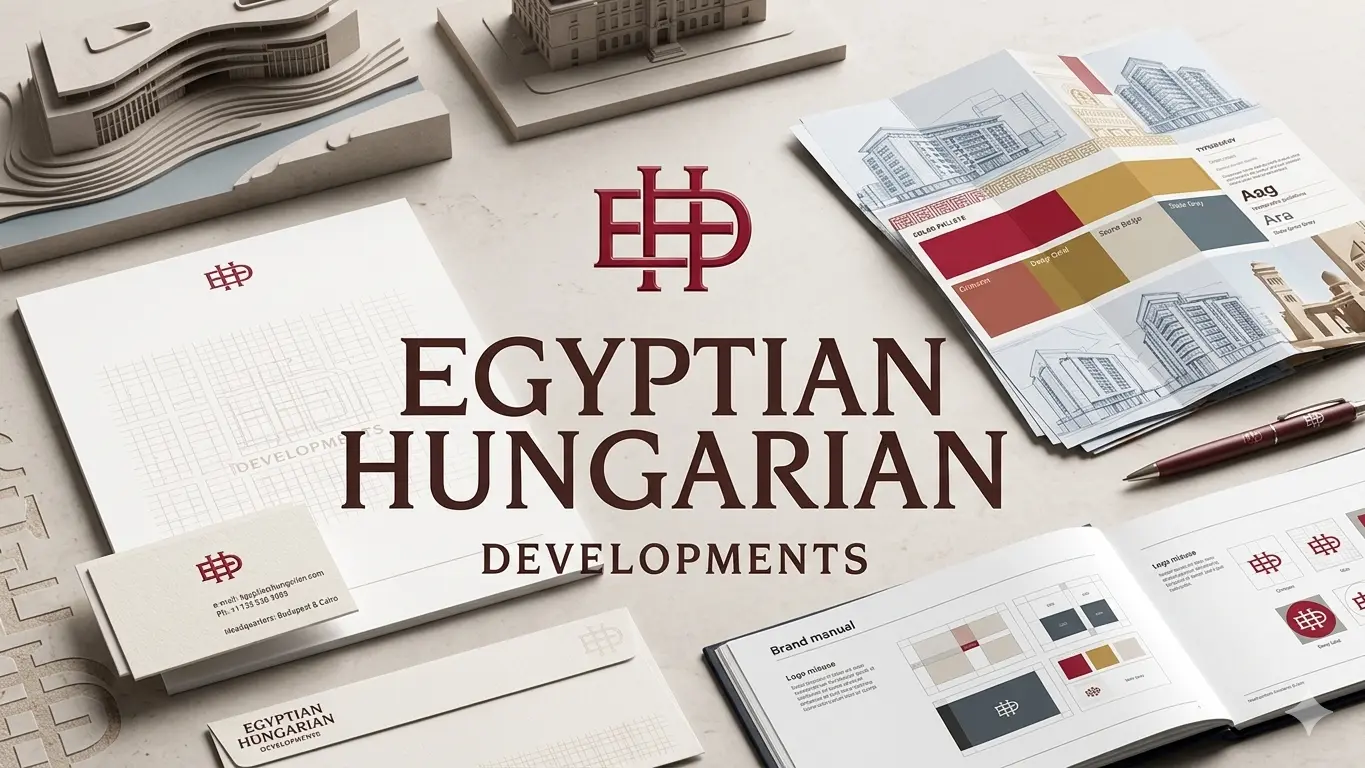
Want to see what a completed brand strategy looks like for an Egyptian business or real estate developer? Take a look at our work and see how we have applied this framework for EHD, Salam Communities, C Developments, and more.
Frequently asked questions
Q: How long should a brand strategy outline be?
One to two pages is the ideal length. Long enough to cover the six sections properly, short enough that your team will actually read and use it. If it becomes a 40-page document, it stops being a working tool and starts being a filing cabinet.
Q: How often should you update your brand strategy outline?
Review it once a year or when something significant changes, such as a new market, a new product line, or a major shift in your audience. Do not update it every time a campaign does not work. The outline is a long-term document, not a reaction to short-term results.
Q: Do small Egyptian businesses need a brand strategy outline?
Yes, and they benefit from it more than large companies do. A small business cannot outspend the competition on advertising. A clear brand strategy outline lets you compete on clarity and consistency instead of budget. It is one of the most valuable documents a small Egyptian business can have.
To summaries
A brand strategy outline is not a complicated document. It is six sections that answer the questions every Egyptian business needs to answer before it can communicate consistently. Get these six things clear and everything else, your campaigns, your sales materials, your social media, becomes easier to produce and more effective at building the right perception in your market.
The next step is understanding how your brand strategy connects to everything you put out publicly. Our article on branding strategy in marketing explains how the two work together with real Egyptian brand examples.