
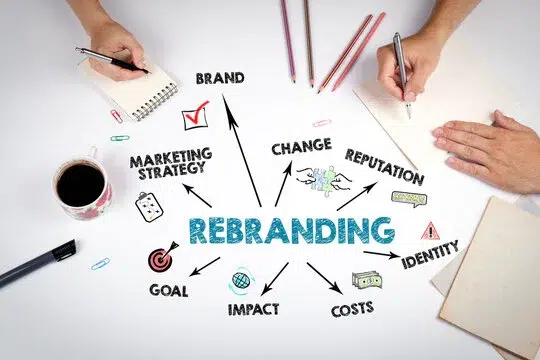
Every company eventually outgrows its own brand. A name chosen five years ago, a visual identity built for a different market, a positioning that no longer reflects what the business actually does — these gaps show up quietly at first, then become impossible to ignore. The companies that navigate this well don’t just “get a new logo.” They follow a deliberate rebranding strategy that protects what customers already trust while repositioning the business for where it’s headed next.
This guide breaks down what a rebranding strategy actually involves, when a company needs one, and how to avoid the mistakes that turn a rebrand into a costly misstep.
What Is a Rebranding Strategy?
A rebranding strategy is the structured plan behind changing how a company presents itself — its name, visual identity, messaging, or positioning — in a way that’s grounded in research and business goals, not just a desire for something new. It typically addresses three questions before any design work begins:
- Why now? What has changed — the market, the audience, the business model — that makes the current brand no longer fit?
- What stays, and what changes? Which elements of brand equity (recognition, trust, associations) are worth preserving, and which need to be left behind?
- How will the transition be communicated? A rebrand executed without a communication plan often confuses the exact customers it was meant to win over.
Signs a Company Needs to Rebrand
Not every business needs a full rebrand, and confusing a slow sales quarter with a branding problem is a common mistake. A rebranding strategy is usually justified when:
- The company has expanded into new markets or services the original brand doesn’t represent
- A merger, acquisition, or change in ownership has changed what the business actually is
- The brand carries negative associations that a fresh visual refresh alone can’t fix
- The original name or identity creates confusion, was hard to trademark, or doesn’t translate well internationally
- Growth has outpaced the brand — the company now operates at a scale or price point the old identity undersells
The Rebranding Strategy Process, Step by Step
1. Audit and Research
Before anything changes, a serious rebranding process starts with understanding the current brand’s perception — through customer interviews, competitor analysis, and an honest audit of what’s working and what isn’t.
2. Repositioning
This is where the company defines its new value proposition: who it serves now, what makes it different, and how it wants to be perceived going forward.
3. Naming and Verbal Identity (if needed)
Not every rebrand requires a new name. But when it does, this step involves testing names for clarity, trademark availability, and cultural fit across every market the company operates in.
4. Visual Identity Development
Logo, color, typography, and design systems are built to express the new positioning — not chosen for their own sake, but as a direct translation of the strategy defined earlier.
5. Rollout and Communication
A phased rollout — updating digital properties, physical signage, marketing materials, and directly notifying existing customers — prevents the confusion that damages trust during a transition.
How Native Studio Approaches Rebranding Strategy
Native Studio builds its rebranding work around the principle of being “Rooted in Real” — the belief that a new identity has to be carved from a company’s actual substance, not assembled from whatever looks current. According to the studio’s own published guidance, a thorough branding strategy project typically takes six to twelve weeks, depending on business complexity and the depth of research required, with visual identity development adding another four to eight weeks on top of that.
OG Selfs Rebranding by Native Studio
- The Approach: We believe a brand’s new identity must be carved from its actual substance, not just current trends. We applied this philosophy to define OG Selfs’ genuine positioning.
- The Scope of Work:
- Established a solid Brand Architecture.
- Designed a strategic Color System.
- Developed a high-impact Sales Kit.
- Created consistent Zone-Based Identities.
The Result: Through a comprehensive rebranding strategy spanning few weeks, Native Studio built a solid brand architecture, custom color system, and zone-based identities for OG Selfs, successfully crafting an authentic visual identity rooted in the company’s actual substance.
 Thinking Through a Rebrand?
If your business has outgrown its current identity, Native Studio’s team can walk you through what a real rebranding strategy process looks like for your company.
Contact Us Whats AppFrequently Asked Questions
How long does a rebranding strategy take? A thorough strategy phase typically takes six to twelve weeks, with visual identity development adding another four to eight weeks — meaning a full rebrand often spans three to five months from research to rollout.
What’s the difference between a rebrand and a brand refresh? A brand refresh updates visual elements — colors, typography, logo details — while keeping the core name and positioning intact. A full rebrand changes the underlying strategy, and often the name itself.
Does rebranding always mean changing the company name? No. Many rebrands keep the existing name and focus entirely on repositioning, messaging, and visual identity. A name change is only necessary when the existing name actively works against the new direction.
What’s the biggest risk in a rebrand? Losing existing customer trust during the transition — usually caused by changing too much at once without a clear communication plan explaining why the change is happening.
Who should be involved in a rebranding strategy project? Beyond the branding agency, the strongest rebrands involve leadership (for direction), sales or customer-facing teams (for market insight), and often a small group of loyal customers consulted early in the research phase.