The question always arrives a week after the event. The CFO looks at the invoice from the hotel, the production house and the artist, and asks what it bought. Marketing answers with photos, attendance and a few hundred Instagram stories. Nobody in the room is satisfied. For developers and corporate brands in Egypt and the GCC, a single brand event can cost as much as a quarter of digital media, so measuring event ROI for brands is no longer a nice extra. It is the only way to defend the next budget. This guide explains how to measure it properly, using the formula everyone quotes and the parts most guides leave out.
Key Takeaways About Measuring Event ROI for Brands
- Event ROI = (event value − event cost) ÷ event cost × 100. When measuring event ROI for brands, the formula is easy; deciding what counts as value and cost is the real work.
- Choose your measures before the event, by format: a launch, a broker night and an exhibition stand do different jobs.
- In Egypt, most event leads move through WhatsApp, brokers and sales centers, so attribution has to be planned for those channels.
- Real estate sales cycles are long. Track results for 90 to 180 days, not one week.
How Do You Measure Event ROI?
To measure event ROI, subtract the total event cost from the value the event produced, divide by the cost and multiply by 100. When measuring event ROI for brands and developers in Egypt and the GCC, value means attributed reservations, qualified leads, broker activity and brand lift, tracked through unique codes, WhatsApp tags and CRM sources for at least 90 days.
The local part matters more than the formula. In Cairo, a buyer may hear about a project at a launch, ask a broker on WhatsApp two weeks later and reserve at the sales center a month after that. If the event did not leave a trace on that path, its return will look like zero, even when it did the heavy lifting.
Why Most Event ROI Reports Don’t Convince Anyone
The usual post-event report counts what was easy to count: guests, photos, reach, press mentions. These numbers describe the event. They do not show what it changed. Most of these problems start before the night: you cannot measure a result nobody defined.
The Event ROI Formula, With the Inputs Done Properly
The formula for measuring event ROI for brands is simple:
Event ROI (%) = (event value − event cost) ÷ event cost × 100
The mistakes happen in the inputs.
Event cost should include everything, not only the invoices marketing sees: venue, production, artist, catering, printing, giveaways, agency fees, staff time, transport, permits and the media that promoted the event. Teams that leave out staff time and promotion make their results look better than they are, and the CFO usually notices.
Event value is where judgement comes in. For a developer, it usually has four parts:
- Attributed sales: reservations and contracts that can be traced to guests or event-specific codes.
- Pipeline: qualified leads and booked meetings, valued at your historical conversion rate.
- Broker momentum: registrations and sales from brokerages that attended.
- Brand value: press, content and brand lift. Report these separately rather than forcing a money value onto them.
A Worked Example (Illustrative Numbers)
The numbers below are illustrative only, to show the method. They are not market prices or results from a real project.
|
Input |
Example figure |
| Total event cost |
EGP 6,000,000 |
|
Reservations traced to the event within 90 days |
12 units |
| Average gross margin per unit |
EGP 1,500,000 |
|
Attributed value (12 × 1.5M) |
EGP 18,000,000 |
| Event ROI |
(18M − 6M) ÷ 6M × 100 = 200% |
Notice that the value uses margin, not the full unit price. Using the full price inflates the result and is the fastest way to lose the finance team’s trust.
Want this set up before your next launch? Book a call with Native Studio and we will map your goals to the right measures before the event brief goes out.
Call us Whats appMeasuring Event ROI for Brands: KPIs by Event Format
Different formats do different jobs, so they need different measures. Getting this right is hard everywhere: Forrester’s research on B2B events found that demonstrating ROI is the number one priority for event teams, and that the first obstacle is a failure to agree on clear goals before the event.
|
Format |
Main job | KPIs that matter |
| Project launch | Create demand |
Reservations and EOIs in 90 days, qualified leads, cost per qualified lead |
|
Broker night |
Arm the sales channel | Brokerages attending, broker registrations, broker-sourced sales in 60 days |
| Investor dinner | Build confidence |
Follow-up meetings, term sheets or partner conversations started |
|
Exhibition stand (e.g. Cityscape) |
Capture interest at scale | Leads per day, cost per lead, meetings booked during the show |
| Ramadan iftar or suhoor | Strengthen relationships |
Repeat buyers, referrals, partner feedback |
Pick two or three KPIs per event. A report with fifteen metrics is a report nobody reads.
Tracking Results in Egypt: Attribution That Survives WhatsApp
Most guides to measuring event ROI for brands assume leads arrive through a form and a CRM. In Egypt, they often arrive as a WhatsApp message to a salesperson’s personal number. Plan for that:
- Give the event its own codes. A QR code on the invitation and stage screen that opens an event-specific page or WhatsApp chat with a pre-filled message. Run the same tag through any paid promotion too: every ad in a social media campaign for real estate that pushes the event should carry it, so online and offline leads land in one report.
- Tag every lead at the source. Agree with the sales team on one CRM source value for the event, and make it mandatory.
- Give brokers trackable assets. Broker kits with their own codes show which brokerages turned the event into sales.
- Measure brand lift where buyers search. Compare branded search and social mentions before and after the event. A corporate brand audit done before the launch gives you that baseline, so the change after the event is real and not a guess.
There is a good reason to take offline experiences seriously in this market. Ipsos found that 42% of Egyptian consumers prefer to engage with brands offline, with in-person visits close behind social media as a preferred channel. Events reach that audience. The task is to make their effect visible.
When Event ROI Is the Wrong Question
Measuring event ROI for brands is not always the right test: some events should not be judged by direct return. An investor dinner may produce nothing measurable for months, then a partnership that changes the company. A Ramadan gathering for long-term clients protects relationships rather than creating new sales. For these, set objectives in advance, such as meetings started or partner feedback, and report against those instead of forcing a percentage.
The honest answer is sometimes “this event was about trust, and here is how we know it worked”. That is still a measured answer.
Where Native Studio Fits
Measuring event ROI for brands starts with design. When the invitation, the stage screens, the broker kit and the landing page are built as one brand system with tracking built in, the return becomes something you can actually report. We plan the brand side of events with those measures in mind, and work alongside your event and sales teams to make them stick. See our branding services for the full scope.
Proof: Measuring What a Brand Change Did
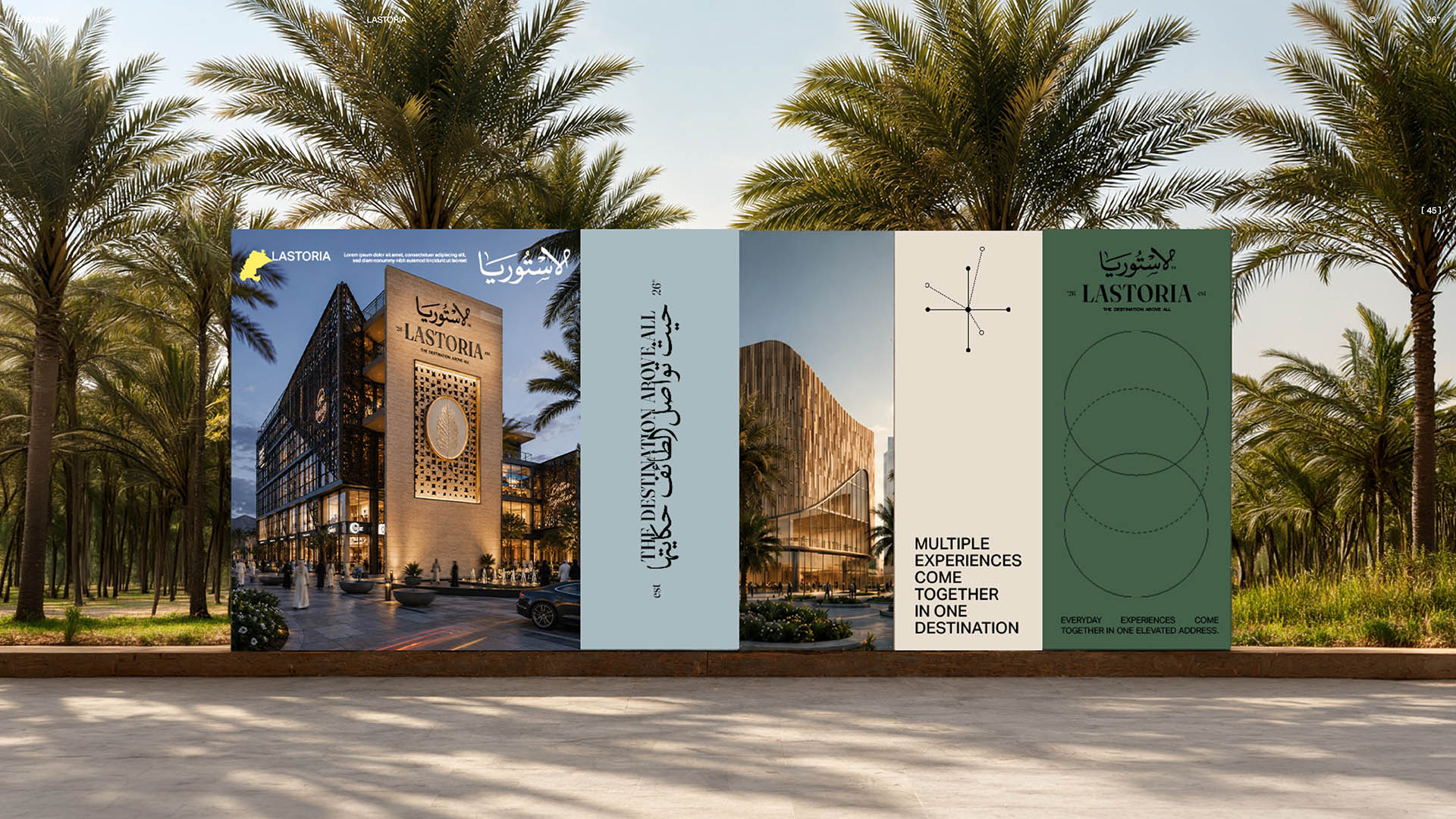
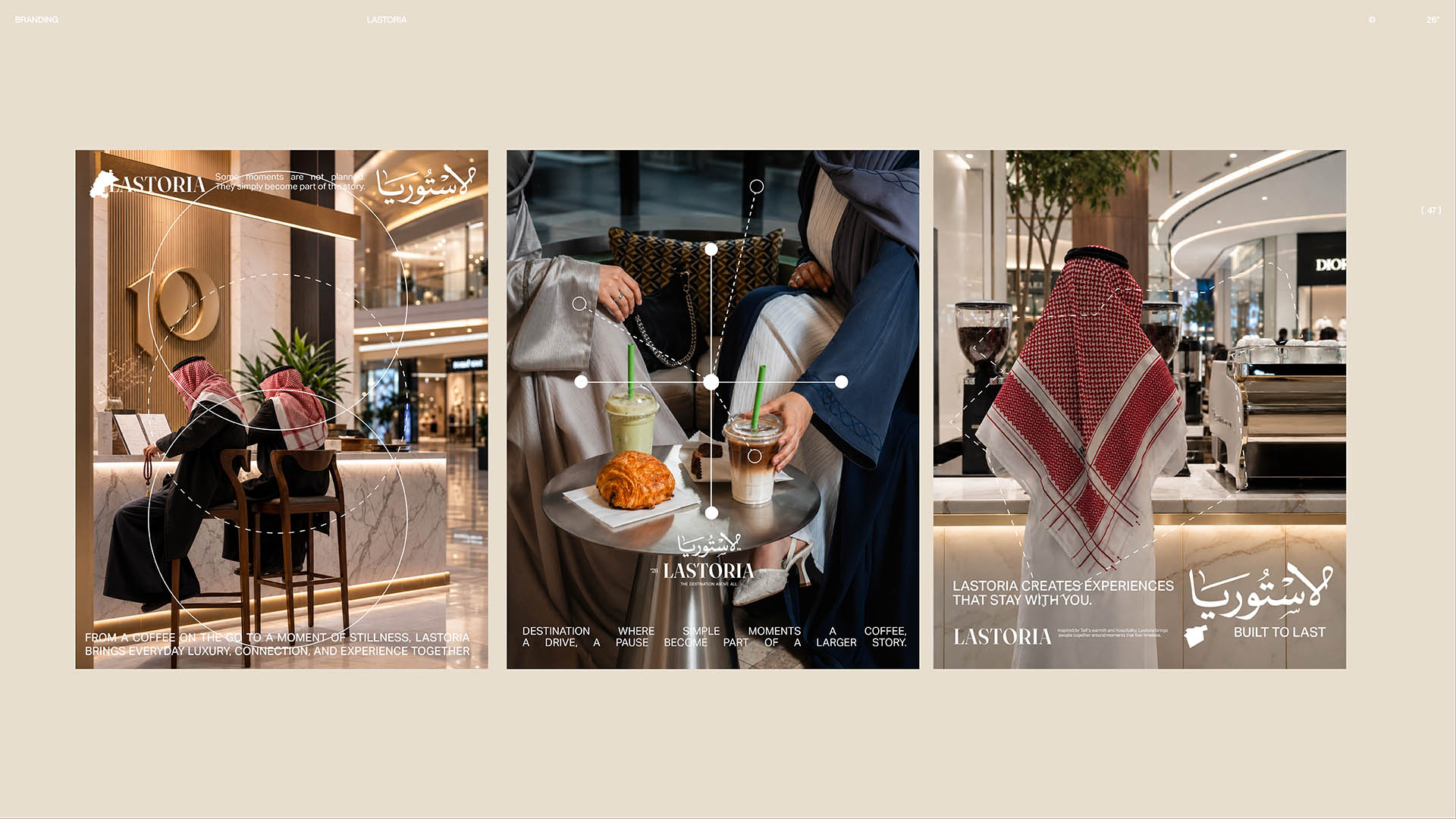
For LaStoria, a retail, dining and lifestyle destination by Sumou Holdings in Taif, we worked on the brand strategy, the name, the campaign platform, the storytelling and the outdoor and social communication. The brief was to position it beyond a typical commercial destination: a place people come to experience, not simply visit. A brand with that promise is judged the same way as an event, by whether people come, stay and return. So the measures have to be agreed before launch, with a baseline for visits, repeat visits and branded search across Taif, rather than reconstructed afterwards. Events deserve the same discipline.
 Executive FAQs About Measuring Event ROI for Brands
What is a good event ROI?
There is no universal benchmark, because the value side depends on your margins and sales cycle. A better test when measuring event ROI for brands is to compare each event with your other channels: if a launch produces qualified leads at a lower cost than digital media, it is earning its budget.
How long after an event should we measure?
For real estate, at least 90 days, and up to 180 for premium projects with longer decision cycles. Report early indicators at two weeks and final results at the end of the window.
Can we measure event ROI without a CRM?
Yes, but it is harder. A shared sheet with lead source, broker, unit interest and status, updated by the sales team, is enough to start. The discipline matters more than the software.
Should brand value be included in event ROI?
Report it alongside, not inside. Press, content and brand lift are real, but turning them into money values invites argument. Keep the financial figure clean and show brand results next to it.
Who should own event ROI reporting?
Marketing should own it, with sales agreeing on the lead definitions before the event. When both teams sign off on the measures in advance, the final report is trusted.
Measure It Before You Spend It
Measuring event ROI for brands starts before the event, not after it. Define the job of the event, agree on two or three measures, build tracking into every touchpoint and give the results enough time to arrive. Then the next budget conversation starts with evidence instead of photos.
If you are planning a launch, broker night or exhibition in Egypt or the GCC, talk to Native Studio about building the measures into the brand from day one.
Call us Whats app