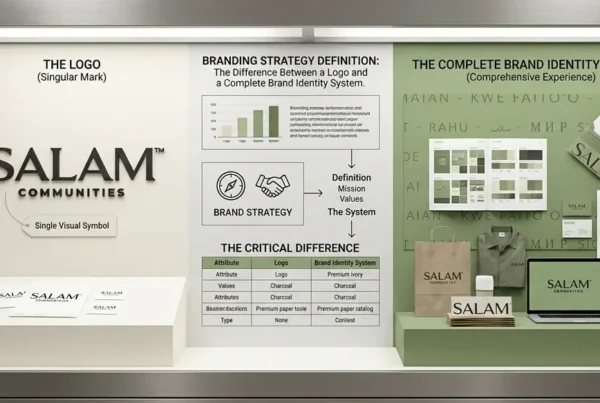

“Branding and rebranding” are used almost interchangeably, and that mix-up costs businesses real money. One is what you do when you’re starting from nothing. The other is what you do when something you already built stops working. Confusing the two leads to the most common mistake we see: a company pays for a full rebrand when a lighter brand refresh would have solved the actual problem — or worse, keeps patching an identity that needed to be rebuilt from the ground up.
This guide breaks down what separates branding and rebranding, how to tell which one your business actually needs, and what it looked like when real companies in Egypt got it right.
At Native Studio, we’ve walked companies through exactly this decision — this guide shares what that process actually looks like.
What’s the Actual Difference Between Branding and Rebranding?
Branding is the process of building an identity where none exists yet — a new company, a new product line, a founder turning an idea into something with a name, a look, and a voice. There’s no baggage to work around, just a blank page.
Rebranding is different in kind, not just degree. It means an identity already exists — and something about it is actively working against the business. Maybe the market shifted. Maybe the company outgrew its original positioning. Maybe the name itself became a liability. A sound rebranding strategy starts by diagnosing what’s broken before touching a single visual element.
Treating branding and rebranding as the same service is where a lot of engagements go wrong from the first meeting — the discovery process for each is genuinely different.
Need help with branding and rebranding? Talk to Native Studio
Signs You Need Branding vs. Signs You Need Rebranding
You likely need branding if:
- You’re launching a new company, product, or division with no existing identity
- You have a name and an idea, but no visual system, tone, or positioning yet
- You’re a startup trying to raise funding or attract your first customers
You likely need rebranding if:
- Your current identity actively undersells what the business has become
- You’ve expanded into new markets or price points your old brand doesn’t support
- Customer feedback or sales data suggests the brand looks outdated, generic, or untrustworthy
- A merger, pivot, or leadership change means the old story no longer fits
If more than two of the rebranding signs sound familiar, the conversation isn’t “do we need new branding” — it’s “how much of the existing identity is actually worth keeping.”
Real Rebranding in Action: Lessons from Egypt
Case studies make this concrete faster than theory does, and some of the clearest examples of branding and rebranding done right come from rebranding a real estate company in Egypt’s property sector — a market where the wrong identity can cost a developer serious credibility with buyers and banks alike.
Cairo Heights became C Developments — a full rebrand triggered by a shift in market positioning, not a cosmetic update. SPD became Salam Properties, moving from an internal, operational-sounding name to one built to carry weight with buyers directly. And Golden View’s repositioning addressed a different problem entirely: separating a luxury offering from a brand that had started to read as mid-market.
None of these were logo swaps. Each started with the same question this guide opened with — what’s actually broken, and what needs to be built to fix it.
 What Branding and Rebranding Cost
Brand identity design cost depends heavily on scope, but a rough frame helps early planning:
- New branding for a startup or new venture typically runs lower, since there’s no existing brand equity to untangle or preserve.
- A brand refresh (updated visuals, same core identity) sits in the middle — faster and cheaper than a full rebrand.
- A full rebrand — new name, new positioning, new visual system, often a new website — costs the most because it touches everything a brand touches, from signage to sales decks to the visual identity system itself.
Any agency handling branding and rebranding work should be able to tell you upfront which category your project falls into — and why — before pricing anything.
How Native Studio Approaches Branding and Rebranding
Native Studio works with founders, developers, and enterprises across Egypt, Saudi Arabia, Qatar, the UK, Turkey, the US, Malaysia, Singapore, Indonesia, Ghana, and Australia, and the same diagnostic process applies everywhere we work — the market context changes, the method doesn’t:
- Diagnose before designing — for rebranding specifically, we identify exactly what’s broken before touching visuals, so the new identity solves a real problem instead of just looking different.
- Preserve equity where it exists — a rebrand doesn’t have to mean starting over completely; recognizable elements worth keeping stay, and only what’s actively hurting the business gets rebuilt.
- Build for where the business is going, not just where it is — whether that’s a startup’s first identity or a 10-year-old company repositioning for a new market, the brand is built for the next stage, not just the current one.
Whether you need branding because you’re starting from zero, or rebranding because something isn’t working anymore, the diagnostic conversation is the same first step — see our full branding and rebranding services for exactly what that process covers, regardless of which of our markets you’re building in.
Not sure whether your business needs branding or a rebrand? Talk to Native Studio
Contact Us Whats AppFrequently Asked Questions
What is the difference between branding and rebranding?
Branding builds an identity from nothing. Rebranding changes an existing identity that's no longer working — due to market shifts, growth, or a name or look that's become a liability.
How do I know if I need a full rebrand or just a refresh?
If your core positioning is still accurate but the visuals feel dated, a refresh usually solves it. If the market has shifted, you've outgrown your original name or story, or trust in the brand has eroded, a full rebrand is typically the better investment.
Is rebranding riskier than starting a new brand?
It carries a different risk: losing existing customer recognition if the transition isn't managed carefully. That's why diagnosing what to keep versus what to rebuild matters more in rebranding than in branding from scratch.
Does rebranding always mean changing the company name?
No. Many rebrands keep the name and rebuild the visual identity, tone, and positioning around it. A name change, like Cairo Heights becoming C Developments, only happens when the name itself is part of the problem.