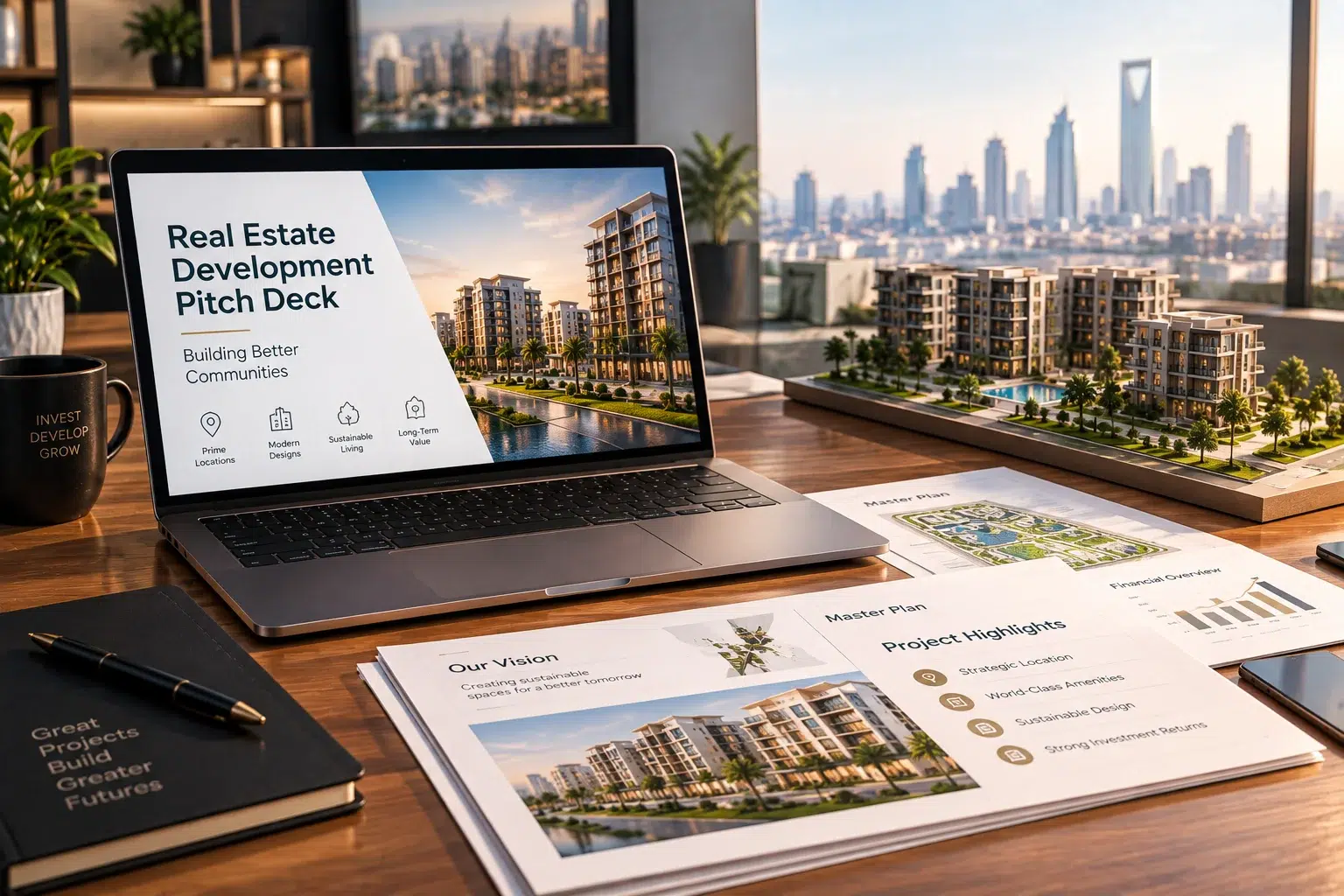
Securing institutional backing or private equity for major land acquisition, mixed-use commercial projects, or residential compounds requires far more than basic architectural renders and a financial spreadsheet. A real estate development pitch deck must bridge the gap between high-level architectural vision and stringent financial diligence.
Native Studio partners with real estate developers, investment syndicates, and private funds across Egypt, the GCC, and European markets, transforming complex land economics, master plans, and capital structures into visual presentations that close multi-million-dollar funding rounds.
What Sets a Real Estate Development Pitch Deck Apart?
Unlike early-stage tech startup decks, a real estate development pitch deck speaks to seasoned institutional capital, private equity partners, and sovereign wealth investors. These stakeholders scrutinize:
- Location Economics & Spatial Value: Proximity to growth corridors, infrastructure development, and demographic shifts.
- Master Plan Viability & Architectural Merit: Clear site layout, zoning approvals, phasing, and spatial functionality.
- Pro-Forma Clarity: Unambiguous breakdowns of Gross Development Value (GDV), Internal Rate of Return (IRR), absorption rates, and debt-to-equity ratios.
Through our specialized presentation design services, we collaborate with teams alongside our dedicated pitch deck design agency framework to ensure your financial underwriting and development vision are communicated with boardroom clarity rather than cluttered spreadsheets.
For deeper insights into underwriting fundamentals and institutional capital frameworks, explore the research and benchmarks published by the Urban Land Institute (ULI).
Contact Us Whats AppThe Essential 10-Slide Structure for Real Estate Development Pitch Deck
To capture investor confidence, your presentation should follow an intentional, risk-mitigating progression:
- Executive Summary: Project location, land area, asset class (residential/commercial/hospitality), and total funding required.
- The Market Opportunity: Local supply-demand imbalance, demographic trends, and unmet regional market demand.
- The Site & Location: Micro-location metrics, transit corridors, neighborhood absorption rates, and surrounding landmarks.
- Master Plan & Architecture: High-fidelity 3D visual renders, floor plate layouts, and sustainable development standards.
- Development Phasing & Milestones: Land entitlement, permitting, groundbreaking, construction stages, and final handover timelines.
- Financial Projections (Pro-Forma): Projected GDV, Cap Rates, Cash-on-Cash returns, IRR targets, and realistic sensitivity models.
- Capital Stack & Use of Funds: Breakdown of sponsor equity, mezzanine debt, bank financing, and investor allocation.
- Exit Strategy: Sell-out duration, long-term asset management yields, or institutional recapitalization plans.
- Sponsor Track Record: Past portfolio scale, historical delivery performance, and development team leadership.
- Investment Terms & Next Steps: Minimum capital commitment, drawdown schedule, and diligence room access.
When presenting to large investor conferences or live boardroom panels, tailoring your assets for high-resolution keynote presentation design ensures crisp typography, flawless motion transitions, and executive poise.
3 Fatal Design Mistakes in Property Pitch Decks
1. Drowning Slides in Raw Spreadsheet Screenshots
Investors need immediate cognitive clarity. Convert dense financial underwriting tables into high-contrast data visualisations and clear callout metrics (IRR, ROI, Cap Rate).
2. Treating 3D Renders as Unrelated Decoration
Renders must serve a storytelling role within the overall deck presentation design. Each visual should highlight spatial efficiency, high-end tenant appeal, or phased construction feasibility.
3. Ambiguity in the Capital Stack
Be transparent about who is taking first-loss risk, current land acquisition status, and where new investor equity sits within the capital hierarchy.
Navigating Local vs. International Capital
Securing capital requires tailoring your real estate development pitch deck to regional investor priorities:
- Gulf & Egyptian Private Equity: Prioritizes land title security, off-plan absorption velocity, and rapid cash generation.
- European & Global Funds: Focuses on ESG compliance, sustainable master planning, and conservative debt refinancing.
Native Studio bridges this cross-border divide, translating complex joint-venture capitalization tables and multi-phase master plans into persuasive, institutional-grade presentations.
Secure Capital with an Authoritative Presentation
Whether presenting a boutique development or a flagship master-planned landmark:
- Request a Real Estate Development Pitch Deck Audit: Contact Native Studio
- Direct Consultations: hello@nativestudio.net | Chat on WhatsApp
FAQs About Real Estate Development Pitch Deck
How long should a real estate development pitch deck be?
A master investor deck typically ranges between 12 to 20 slides. A concise 12-slide version serves as the initial "teaser" sent via email, while the comprehensive 20-slide version is utilized for live partner meetings alongside the virtual data room.
What do institutional real estate investors look for first?
Sponsor track record and conservative debt assumptions. Capital allocators want to verify whether the developer has successfully delivered comparable assets on schedule and within budget.
What financial metrics must be highlighted in a real estate development pitch deck?
Institutional investors look directly for Gross Development Value (GDV), Internal Rate of Return (IRR), Equity Multiple, Cap Rates, and debt-service coverage ratios. An effective real estate development pitch deck presents these indicators within clean summary tables alongside your capital stack rather than burying them inside text paragraphs.
Should the real estate pitch deck design include 3D animations or static renders?
For live boardroom presentations, high-resolution static architectural renders paired with subtle slide transitions are preferred to prevent technical latency. If you have 3D walkthroughs, link them through interactive buttons or QR codes within your real estate pitch deck design so capital allocators can explore project feasibility in their data room at their own pace.
Can Native Studio help restructure an existing property development presentation?
Yes. As a specialized design agency, we regularly audit existing property decks to eliminate cluttered layouts, recraft the underlying narrative progression, and ensure financial underwriting charts align with modern institutional presentation standards.